
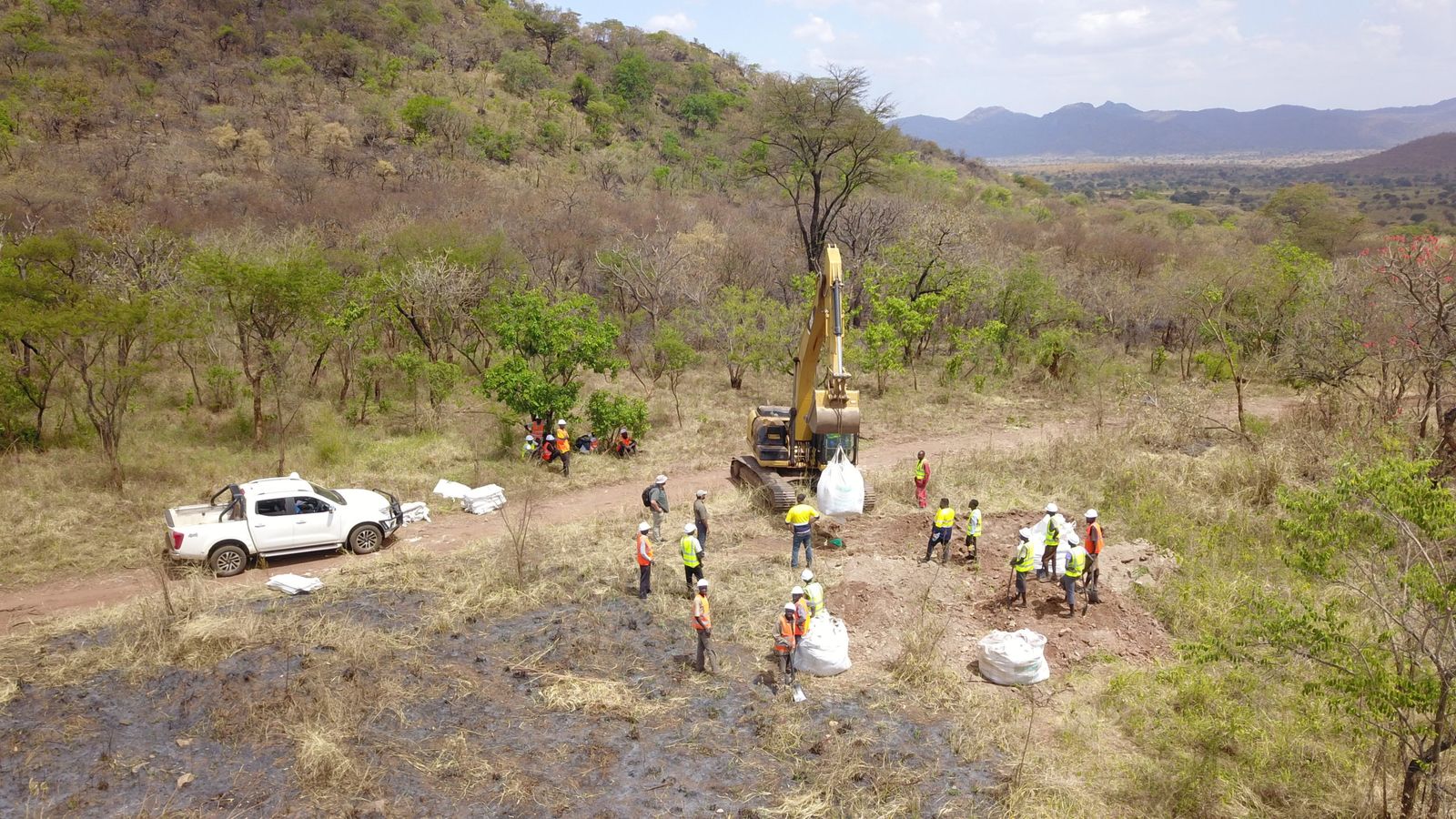

Broker Cavendish has released an extensive note on the global graphite market, highlighting several major up-and-coming companies, including Blencowe Resources (BRES ), which is developing the Orom-Cross graphite project in Uganda.
“China currently accounts for over 90% of global graphite anode material production, leaving downstream manufacturers highly exposed to supply disruption,” wrote Cavendish’s analysts.
“Unsurprisingly, China’s weaponisation of critical mineral export controls amidst escalating geopolitical tensions has heightened concerns and intensified Western OEM and government efforts to secure ex -China graphite supply chains. We therefore believe it is an opportune time for investors to evaluate graphite development opportunities.”
Among those Cavendish draws its clients’ attention to are Syrah, with its Balama operation in Mozambique, and Blencowe in Uganda.
“The highest -grade graphite deposits are not necessarily the most attractive projects,” continued Cavendish.
“Unlike many mined commodities, graphite project economics are driven less by resource grade and more by flake size distribution, operating costs, capital intensity and the ability to maximise value across multiple markets. As a result, lower-grade deposits can ultimately generate superior investment returns than higher-grade peers. Flake size distribution is the key determinant of concentrate economics: coarse flakes command premium pricing and face limited competition from synthetic graphite, while fine-flake concentrates are lower-value products unless upgraded into battery anode materials. The strongest projects can monetise both ends of the flake spectrum.”
The broker went on to highlight projects from Blencowe, and another company, EcoGraf, as being attractive for their ability to serve multiple end markets.
“By selling higher-value coarse flakes into industrial applications while upgrading lower-value fine flakes into battery anode materials, they diversify revenue streams, reduce dependence on any single end market and maximise value capture across the full flake size distribution. They also reduce downstream capital requirements and improve capital efficiency, as only the lower-value fine fractions require further processing to achieve attractive margins. Blencowe and EcoGraf are examples of developers pursuing this dual-market strategy. Some developers have sought to manage battery anode material-related risks through development strategies. Blencowe, for example, has outlined a five-phase development plan designed to reduce technical, commercial, market and financing risks. Phase 1 is effectively a commercial-scale validation phase for the concentrator. During P1, downstream production is to occur via toll processing with technical partners. This should enable participation in higher-value product markets without the immediate capital investment and execution risks associated with constructing downstream processing infrastructure, while also allowing customer qualification to begin before committing capital to an owned downstream plant. Blencowe is ultimately targeting in-house production of USPG (uncoated spheronised graphite). This strategy captures a meaningful proportion of downstream value uplift while minimising risk by allowing customers to undertake coating and other final processing steps within their own supply chains or via toll processing. Coating and associated processing are the most capex-intensive downstream steps, while end-users often have exacting requirements and may have their own proprietary coating technologies. Finally, the phased development strategy also reduces execution and market risk. P1 and P3 provide operational and commercial validation before construction of the first full -scale concentrator and downstream modules, respectively. Subsequent capacity additions are intended to be demand-led.
Cavendish also pointed out that Blencowe’s Orom -Cross project in Uganda is likely to benefit from a 10 -year corporate tax holiday.
“All else being equal, the most attractive concentrate projects,” Cavendish continued, combine “low operating costs with low capital intensity. On this basis, Blencowe Resources’ Orom -Cross, EcoGraf’s Epanko Stage 1, Nextsource’s Molo and Black Rock’s Mahenge appear particularly well -positioned.”
View from Vox
It’s been clear for a good long time now that Blencowe’s project is attractive from a multitude of angles. Partly, we know that because the company seems to have no trouble at all in signing up off-take partners. But we know it too from the continual growth the project has shown over the years, and from the various routes to market as laid out here by Cavendish. Plenty of food for thought.