
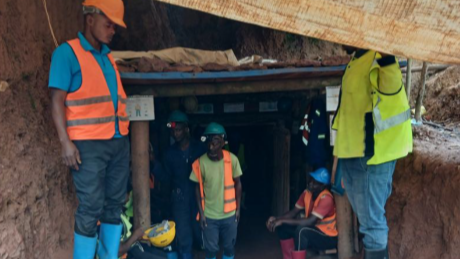

Rome Resources (RMR ) has announced maiden tin production at its Kalayi project in the Democratic Republic of Congo.
The pilot mining operation at Kalayi has produced an approximately 75% cassiterite concentrate from ore mined at surface and processed on site.
Approximately 2,000 kilograms of approximately 58.5% contained tin concentrate, which equates to approximately 75% cassiterite, has been produced on site to date, to be sold at the local facility in Walikale.
The concentrate was produced by simple sorting and sluicing alone, with no complex processing required, with mineralisation running from surface in several of the cassiterite-bearing zones encountered, making the operation readily scalable.
Two shallow adits, horizontal tunnels driven into the hillside, have been opened into the deposit. Adits of this type require no hoisting or pumping infrastructure, making access to near-surface mineralisation straightforward and low cost.
The majority of operations have focused on Adit #2, which has opened a gallery of some 12.8 metres length at 6.4 metres below ground, following a steeply dipping mineralised vein. Ore is crushed and sluiced on site to produce a cassiterite concentrate.
A single sample of the concentrate was separated into a fine-grained component and a medium-grained component and submitted to the regional government laboratory in Beni for analysis by X-ray fluorescence (XRF).
Analysis of the fine-grained component gave 64.82% tin and the medium-grade component 52.15% tin. The average is 58.49% tin, which equates to approximately 75% cassiterite using a theoretical conversion factor of 1.27.
The scale of production is currently constrained by the terms of the Kalayi small-scale mining exploitation permit, the PEPM.
Conversion to a full mining licence would secure long-term tenure and permit production at commercial scale.
The project has received a favourable environmental audit.
Meanwhile, drill pad construction has commenced, with the first four priority pads targeting deeper extension of wide cassiterite intercepts in KBDD025 and KBDD033.
Kalayi’s inferred resource stands at 460,000 tonnes at 1.47% tin, for 6,760 tonnes of contained tin, a 45% increase during 2026, with 20,000 tonnes a realistic combined target.
Rome continues to engage with potential strategic parties regarding the advancement and development of Bisie North.
“Rome is now producing tin concentrate at Kalayi,” said Paul Barrett, chief executive of Rome Resources.
“That represents a meaningful change for the company, achieved by our local team using simple sorting and sluicing, with no flotation and no complex processing circuit. The commercial significance is what I would draw out. The mineralisation runs from surface, the mining method is straightforward and the processing is simple. With tin trading at around US$50,000 a tonne, a deposit of this grade that can be worked this cheaply has compelling margin potential. The constraint on scaling it is not geological and is not technical; it is the terms of our current small-scale permit. Conversion to a full mining licence removes that constraint, and we will update the market in due course.”
He went on to talk about the proposed drilling at Kalayi.
“In parallel we are preparing a targeted drilling programme at Kalayi. The first four pads sit over the deeper projection of the wide intercepts in KBDD025 and KBDD033, which remain open at depth. The programme is sequenced so that the holes most likely to add resource come first. Kalayi already holds 6,760 tonnes of contained tin at 1.47%, up 45% this year, and 20,000 tonnes remains a realistic combined target. Rome continues to engage with potential strategic parties regarding the advancement and development of Bisie North, and we look forward to updating shareholders.”
View from Vox
There’s a lot on offer at Kalayi. Twenty thousand tonnes of contained tin remains a realistic combined target as the southeast extension and the zones outside the current resource are drilled out. With tin currently trading at approximately US$50,000 per tonne, that’s a mouthwatering prospect. In the meantime, getting into pilot-scale production offers useful insights into the potential of a much larger operation in the area. For an example of how that might be done, look no further than Alphamin’s tin processing infrastructure, less than 10 kilometres from Kalayi.