

Rome Resources (RMR ) has confirmed multiple zones of tin, tungsten and indium mineralisation on its New Brunswick project in Canada.
The mineralisation lies within the same intrusive igneous complex that hosts the Mount Pleasant tin-tungsten deposit, one of the largest known tin-tungsten occurrences in North America.
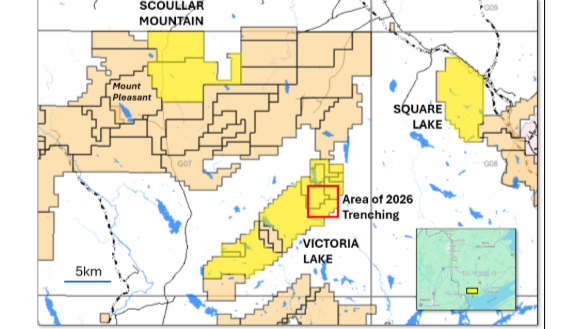
A 2.6 kilometre mineralised tin-bearing quartz breccia has been identified at Scoullar Mountain, within the central part of the Mount Pleasant Caldera, a few kilometres east of the historic Mount Pleasant mine.
Trenching has been completed across a cluster of assayed samples returning up to 0.58% tin and 0.17% tungsten at Victoria Lake, with further assays pending.
The field campaign is ongoing, and thus far comprises 340 outcrop samples and 360 metres of trenching across the 109 square kilometre option area.
Earlier sampling returned 17 parts per million indium, 0.8% bismuth and 1.5% copper, confirming the polymetallic critical mineral potential of the system.
Rome will now exercise its options over its New Brunswick claims, acquiring 100% of the working interest.
In addition, a further land package has been secured through Rome’s partner, taking the position within the Mount Pleasant Caldera sub-area to approximately 40 square kilometres immediately east and northeast of the Mount Pleasant licence
"Mount Pleasant is clearly a key deposit for several critical minerals, situated on the far western rim of the caldera,” said Paul Barrett, chief executive of Rome Resources.
“Our early exploration work indicates that critical mineralisation continues eastwards within the caldera, and the evidence for that is now tangible. We have identified a 2.6 kilometre tin-bearing quartz breccia at Scoullar Mountain, containing stannite alongside purple fluorite. At Mount Pleasant, indium is associated with sphalerite, stannite and purple fluorite, so finding that same assemblage on our own ground tells us we are not simply working near a world-class deposit, we are working within the system that created it. At depth, these targets may develop into highly attractive drill targets that rival if not eclipse the current Mount Pleasant resource. This will be our focus in Canada in 2027, along with additional work along the prospective greisenised part of the Mount Douglas Granite to the southeast, where sampling at Victoria Lake has returned grades of up to 0.58% tin and 0.17% tungsten.”
View from Vox
How big could the New Brunswick project get? Pretty big if the early indications are anything to go by, although obviously there’s still a lot of work to be done. The asset sits well in Rome’s portfolio, alongside the much more advanced assets in the Democratic Republic of Congo. If any transaction occurs on the Congolese assets, huge upside will remain inside the company in Canada. Exercising the option on the assets underlines Rome’s confidence in the Canadian potential, and it will be interesting to watch the project move forward from here. Core drilling is planned in 2027.