
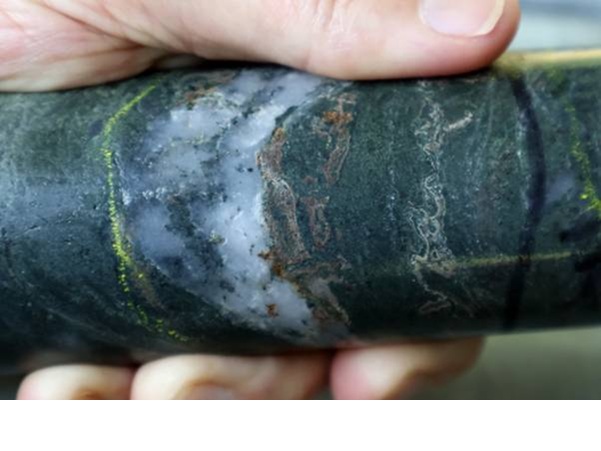

Rome Resources (RMR ) has released the latest on-site results from ongoing drilling at the Kalayi project in the Democratic Republic of Congo.
Two drill rigs have been operating at Kalayi, and four holes have been completed so far, with a further hole approaching its target depth.
According to XRF readings, initial on-site results two metres grading 8.3% tin from 74 metres depth and five metres at 0.48% tin from 86 metres in hole KBD023.
Kalayi hole KBD021 returned two metres at 2.23% tin from 181 metres depth and two metres at 2.33% copper from 107 metres. Kalayi hole KBD022 encountered one metre at 1.89% tin at 54 metres depth, one metre at 1.35% tin at 68 metres depth and one metre at 0.34% tin at 72 metres.
Kalayi hole KBD020 was abandoned at 40.5 metres and redrilled to a depth of 135 metres, without encountering significant tin mineralisation.
The current drilling programme follows on from Rome’s maiden mineral resource estimate for the wider Bisie North project, announced in October 2025.
The focus in on testing extensions of known tin mineralisation at depth at Kalayi ahead of follow-up drilling at Mont Agoma. Up to four further drill holes, including the current hole, are planned on Kalayi to continue testing the down-plunge extent of tin mineralisation, after which drilling will resume at Mont Agoma where Rome is targeting deeper tin-rich zones beneath the established polymetallic system.
The handheld XRF used at Bisie North is a Thermo Scientific NitonTM XL3t model. Readings represent averages of 60 second continuous analysis along one metre sections of core.
The X-ray beam is emitted through an 8mm window and penetrates up to several millimetres into the drill core. Even so, the grades determined by the portable handheld XRF are indicative only and shouldn’t be relied upon for resource estimation. Samples from completed drillholes will be submitted for laboratory assay, with results to be reported in due course.
"We continue to be encouraged by this second phase of drilling at Kalayi, where the intersection of a tin-rich zone at depth is considered consistent with the company's structural model and expectations for high-grade extensions beneath the known mineralisation,” said Paul Barrett, chief executive of Rome Resources.
“These results further support our view that Kalayi hosts high-grade tin shoots that persist below the depths tested to date. Drilling will move to Mont Agoma in the coming weeks."
View from Vox
XRF is pretty good these days, but it’s still necessary to be a little bit cautious ahead of formal assays. Be that as it may, Bisie North is getting a reputation as a project that just keeps on giving. The grades continue to be encouraging, and indicative of significantly more mineralisation present than was initially outlined in the maiden mineral resource. Work continues, and it would be no surprise if additional high-grade mineralised intercepts were encountered in the holes that are yet to be drilled.