
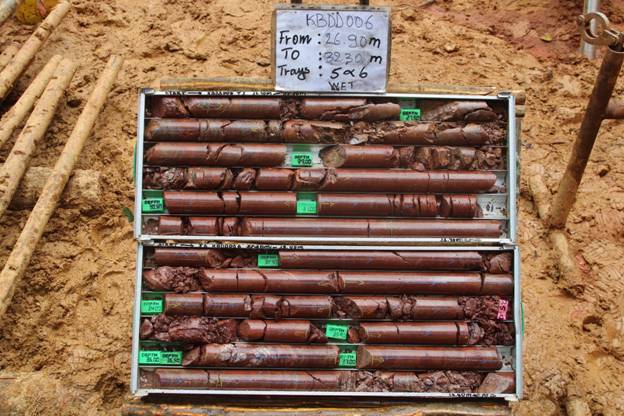

Rome Resources (RMR ) has commented on initial results from additional ongoing drilling at the Kalayi prospect on the Bisie North project in the Democratic Republic of Congo.
Drillhole KBDD033 has delivered the widest tin-bearing intercept encountered at Kalayi to date, with XRF indications of 20 metres showing an average tin content of 1%, including three sub-intervals totalling 10 metres, with 1.7%-to-2.1% tin content, alongside two additional shallower intercepts.
These results support the Rome’s contention that the mineralised system may strengthen and broaden with depth.
Three drill holes have been completed since the last update, and assessed for mineralisation by a handheld XRF device.
On the other two, XRF showed five metres at 1.8% tin from 113 metres, including two metres at 4%, and four metres at 1.1% tin from 101 metres.
The results from KBDD033 represent the widest tin-bearing interval intersected to date at Kalayi.
What’s more, the style of mineralisation in KBDD033 appears comparable to that observed at Alphamin's nearby Mpama South deposit where tin-bearing zones are known to broaden at depth.
While it remains early, the Kalayi results continue to support the company's view that the system has the potential to develop into a broader and more laterally continuous mineralised zone.
In order to assess how these zones evolve at depth, a further hole, KBDD034, is being drilled below KBDD033, targeting the continuation of tin mineralisation between approximately 125 and 225 metres depth.
The portable XRF currently used at Bisie North is a Bruker S1 Titan model. Readings represent averages of 60-second continuous analysis along one metre sections of core. The X-ray beam is emitted through an active area of 20mm2 and penetrates up to several millimetres into the drill core.
The metal grades determined by the portable XRF are indicative only, although they are calibrated against known standard samples. Samples from completed drillholes will be submitted for laboratory assay, with results to be reported in due course.
"The tin intercept encountered in drillhole KBDD033 materially strengthens our view of Kalayi's potential to host substantially greater volumes of tin mineralisation at depth than had been indicated by the shallower intercepts,” said Paul Barrett, chief executive of Rome Resources.
“This is a highly encouraging result, both in terms of scale and geometry, and is consistent with the style of mineralisation seen at Alphamin's nearby Mpama mine. This will feed into our proposed mineral resource estimate update and strengthens our confidence that the proposed mineral resource estimate update could deliver a meaningful uplift. Importantly, this phase of drilling on Kalayi is concluding with the drilling of a follow-up hole beneath KBDD033 designed to test the continuity of this zone at greater depth and further assess the scale of the opportunity."
View from Vox
XRF is only indicative, but at this point the indications it’s giving are very encouraging. We now await the assays with interest. And, only eight kilometres away, no doubt Alphamin will be paying attention too.