
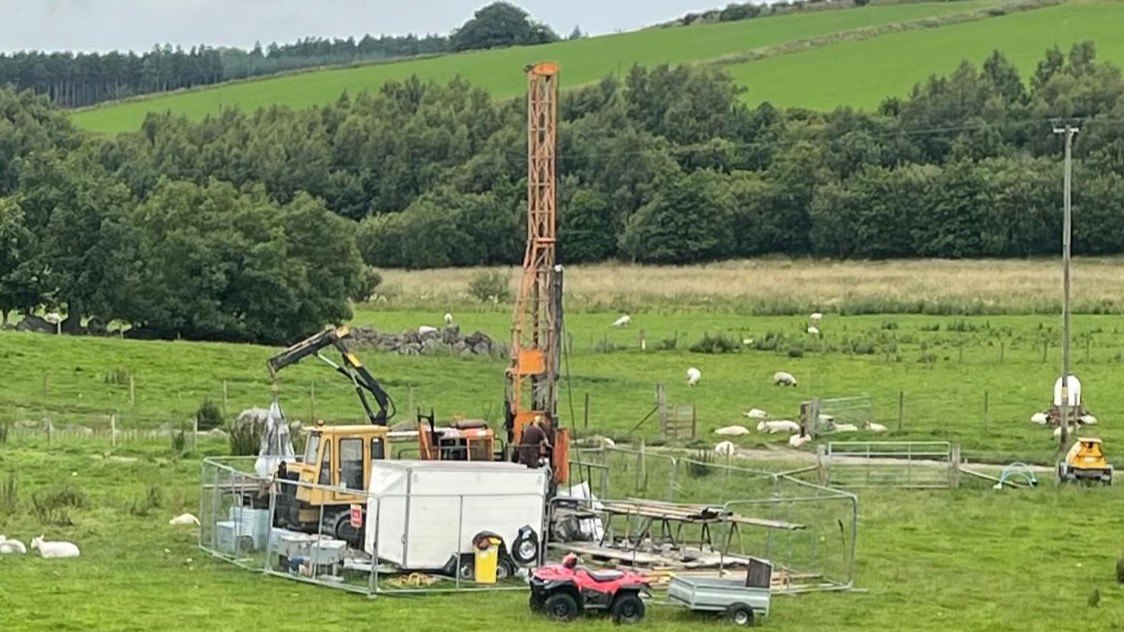

A highly prospective region of Scotland is being opened up for exploration for the first time in more than fifty years.
Winshear Metals (WINS ) is about to get down to serious work on the Portsoy nickel-copper-cobalt project, just sixty kilometres northwest of Aberdeen.
The project lies on land that was the subject of significant investigation by two stellar names in mining – Anglo American and Rio Tinto, more than half a century ago.
Back then both Anglo and Rio, working jointly but on separate parts of the overall landholding, came up with some highly encouraging results. But access issues arose, and Rio and Anglo had plenty of bigger fish to fry elsewhere.
So, the project languished, forgotten, until Peak Nickel started work on it in 2020.
In December 2025 TSX Venture-listed Winshear Metals entered into an option an agreement with Peak Nickel to acquire a 100% interest in the Portsoy project, subject to a royalty to Peak. In February this year Winshear raised C$2.5 million to undertake at least 1,000 metres of drilling at Portsoy, and also to do downhole electromagnetic surveys and some initial metallurgical work.
It looks like Portsoy is about to come alive again.
The background to this development is straightforward enough.
A couple of years ago Winshear was a company looking for assets. It had just exited a complicated situation in Tanzania, returned a significant sum of money to shareholders and tried a brief foray into Peru.
Wondering what to do next, one of Winshear’s founders, former chief operating officer Chris MacKenzie (now the Managing Director of Peak Nickel), was visiting the British Geological Survey in Nottingham and came across an old report on Portsoy.
Intrigued, he sought more information and, as it happens, the BGS still has some of the small diameter drill core taken from Portsoy by Rio and Anglo. So MacKenzie ran an XRF machine over it and was sufficiently impressed with the nickel and copper showings to travel north to negotiate with the landowners.
These negotiations were successful, and MacKenzie secured access and follow-on mining leases that are valid for up to 100 years.
So far so good.
The next step was to confirm that the old data gathered by the majors remains valid. Significant drilling to this end was carried out in 2023 and 2024 by Peak Minerals, a private vehicle that MacKenzie utilised for the purpose, and the results were highly encouraging.
Winshear duly optioned Portsoy from Peak in the second half of 2025. Under the terms of that transaction, Winshear committed to spending £3 million on the project over five years, to grant Peak 6.5 million shares, and to allow Peak to retain a capped 1% net smelter royalty.
The fundraising Winshear completed in February represents the first phase of this latest iteration.
“We’ve started drilling in Scotland,” says Richard Williams, Winshear’s chief executive.
“There are two zones of mineralization identified so far. The South Zone is an east-north-east trending target three kilometres long. And six hundred metres to the north is the North Zone, which could be a kilometre long.”
These are nice enough footprints to be getting down to work on, and the precedents are good. Highlights of Peak’s earlier drilling campaign on the Rodburn target on Portsoy included six0 metres at 1.42% nickel equivalent, 12 metres at 1.82%, 5.97 metres at 2.86%, and 5.39 metres at 2.46%. Cobalt grades are some of the highest in any European nickel deposits.
There is some overburden (glacial till from the last ice age), which is partly why the area wasn’t revisited sooner, but essentially the mineralization starts close to surface.
“Clearly there’s a lot of metal in the system,” says Williams
This initial programme is designed, he adds, “to demonstrate to the broader market that we’ve got good grades, scaleability, and that we’ve got the metallurgical work to prove that we can recover it.”
But he emphasizes too, that Winshear’s plans don’t just involve the one target.
“The Portsoy project area covers 250 square kilometres,” he says.
“There is district-scale potential, based on the underlying geology and previous soil sampling data.”
If that’s right, then Portsoy could be a game-changing project, and not just for Winshear, but for the UK as a whole, which hitherto has not been known to be particularly generously endowed with metals, except for south-west England, which has a long history of copper and tin mining.
In the current global political climate, in which self-sufficiency is once again becoming an issue, that could be a problem; one that the UK government is beginning to appreciate. Winshear could end up becoming a key player in addressing this issue.
That being said, Portsoy isn’t the only string to the Winshear bow.
The company has also allocated a C$400,000 budget for exploration on the 360 square-kilometre Thunder Bay gold project in Ontario. This is classic grass roots stuff, and as such at a somewhat earlier stage than Portsoy. But the prospectivity is good, there’s a lot of other activity in the region, including some big discoveries, and accordingly Winshear plans to do detailed soil sampling and drone magnetic surveys later this year.
What’s the long-term outlook for this project? Williams can envisage a time when perhaps Winshear splits into two companies, one Canadian and one British. Such an outcome is clearly some way away, but there’s nothing like success to focus the mind. So, it will be interesting to see what sort of results come in from this summer’s work, and to see what Winshear does next.