


A Roundhouse AI IPO or Not A Roundhouse AI IPO
This week saw the move from Aquis to AIM of Roundhouse AI (RHAI) Roundhouse AI (RHAI) . It was also the week I got told off regarding my coverages of RHAI. This was not good. If there is one thing I have never liked, from school days onwards, it is being told off. This is largely because I make an obsessive effort to never do anything wrong. And I mean, obsessive. So when I am accused of being wrong, it is not a good situation. This week was a kind of “wrong”, as I described RHAI ringing the bell at the London Stock Exchange as an Initial IPO. Well it was, and it wasn’t. Given that the company focused on building a neutral data and reputation infrastructure layer for autonomous AI agents was new to AIM, it was an initial public offering. But perhaps, given that it had already IPO’d on Aquis, it was not. I prefer to think of it as an IPO, given that the LSE is regarded by most as being a big deal, and that as things stand, AIM really needs as many IPOs as it can get.
In terms of what happened next, even though one could say that building infrastructure for the AI ecosystem is not exactly mainstream – yet, for the shares to end the week up 26% was an amazing result. Indeed, given that it raised £1.6m to achieve a market cap of nearly £20m was very impressive. Not many companies achieve such a ratio between funds raised and market cap in the first few days of dealings. We are talking perhaps a Nasdaq style rating for a UK stock.
The AI Bubble Burst, Again
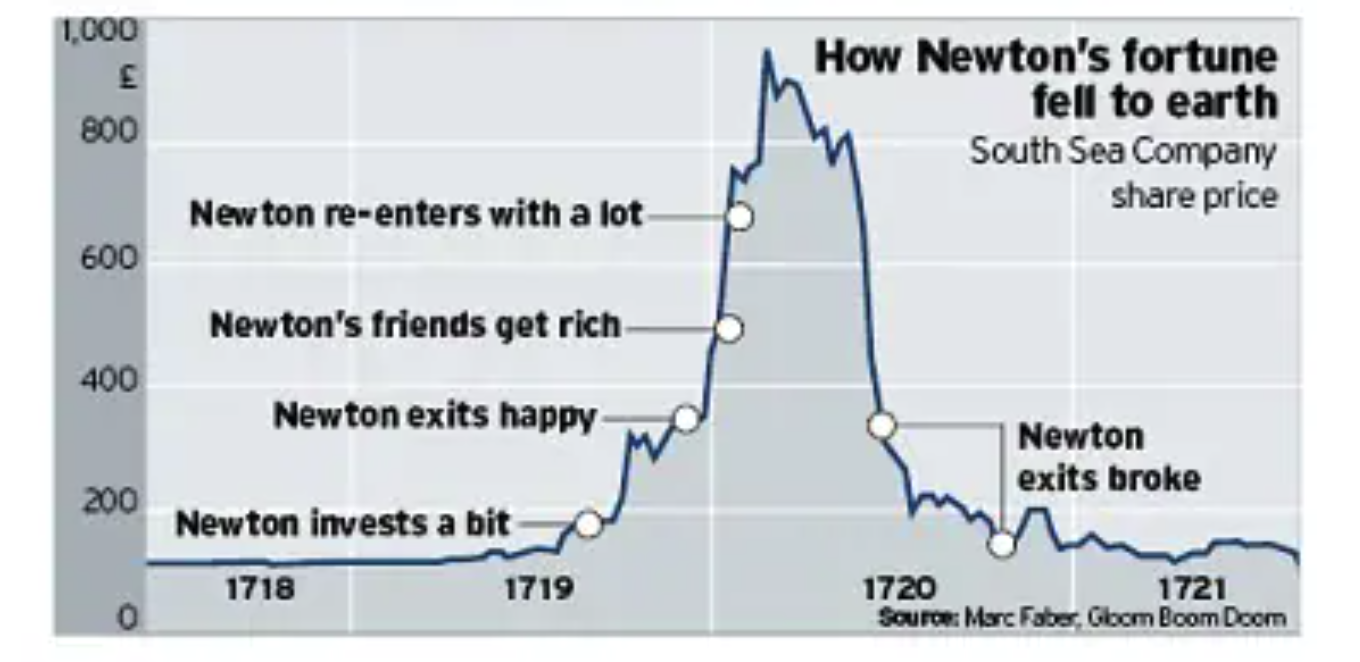
One of the issues with identifying a bubble in any sphere of life is that firstly, it is very difficult to define what a bubble is. Second, all the time you are warning about a bubble you could be making money in it, thirdly, they always tend to last longer than one thinks. Fourth, the bubble bursting is always worse than anyone expects. Even one of the greatest minds who ever lived, Sir Isaac Newton came a cropper from a bubble, losing £20,000 (worth £3m today). In his case it was the South Sea Bubble. In terms of timeframe it lasted about as long as the Dotcom Bubble lasted in the UK.
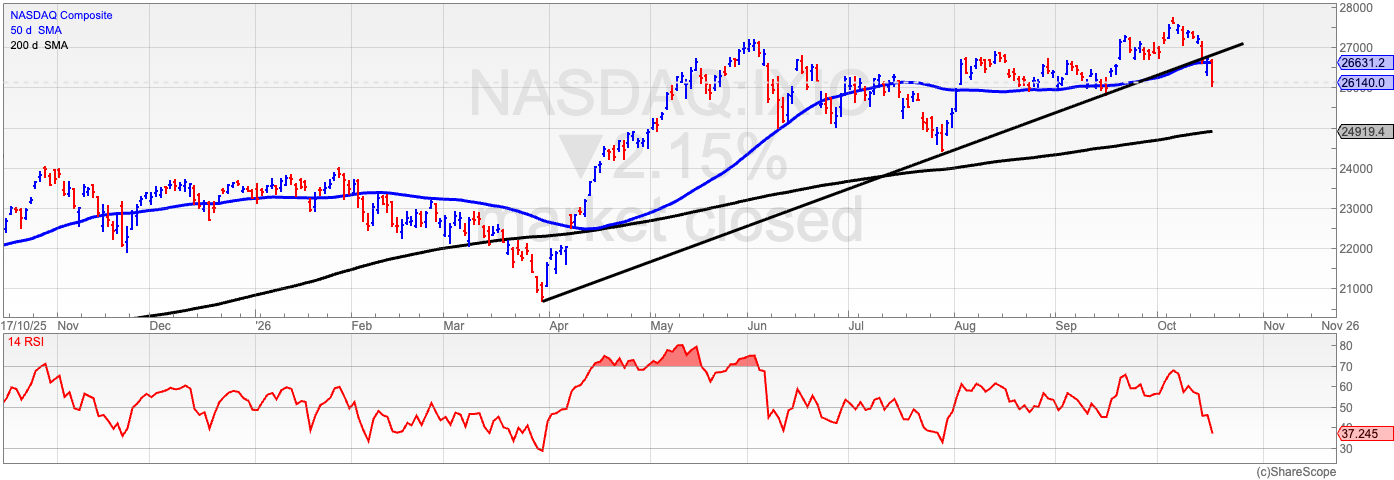
One could argue that the AI bubble is at least two years old, perhaps three and is set to pop. At least, the siren voices calling it down are currently in a frenzy. Plus it is October, a good month of the year to have a crash. I would venture to suggest that this bubble may be different. But that tends to be just another signal that one is ready to burst. As a chartist I can see on the Nasdaq Composite chart that we have broken an uptrend line in place since March. This is mildly serious. However, we are still well above the 200-day moving average at 24,900, and well above the July low at 24,500. It may be a crash starting now, but then again, it has been a great run.
This Week’s Rising Shares
One of the things one does not really want to see as a director of a company is for the shares to rocket on your departure. This is even if it was the right thing to happen. In the case of Fragrant Prosperity (FPP) Fragrant Prosperity (FPP) , a SPAC and a cash shell, the shares jumped 47% on the week as a director left to “focus on other interests.” Presumably, this is not just watching daytime TV, walking the dogs, or spending more time with the family. One would guess that the exit means that a long-awaited deal for FPP is rather more imminent than it has been. Don’t tell me it will be in AI.
Gunsynd (GUN) Gunsynd (GUN) has in the past been something of a quiet backwater in terms of stock market listings. However, the announcement that the previously natural resources investor is going to turn into an operating company seems to have stirred something within the shareholder base. On Friday the company said it was looking into the validity of a notice requisitioning a general meeting of the company. What is interesting that after years of being a not exactly setting the world on fire existence as a subscale investing company, the move to what could be a better manifestation, an operating company. Whatever the case, get the popcorn out. That said, in the recent past on the stock market, it has been very often the case that the wrong things happen on shareholder votes, however you define wrong.
This week I was called up by the powers that be at video editing specialists Blackbird (BIRD) Blackbird (BIRD) to interview the CEO Ian McDonagh, someone whom I have interviewed many times before. However, on this occasion, and quite rightly, he appeared even more ebullient than he normally is. And quite rightly so. We were talking on the occasion of his elevate.io software being placed on the Google Chromebook Perks platform. Clearly, this is massive for distribution, and will be a game changer. The shares were up near 100% on the week. Not only on the news perhaps, but also because it was a great interview. Indeed, the last time I had such a result with an interview was with EnSilica (ENSI) EnSilica (ENSI ) in the spring. So yes, they can move markets, as can the charting.
One of the reasons that the London stock market underperforms the US markets, and many others, is the phenomenon of the “speeding ticket” RNS. This has to be one of the most idiotic happens that can happen on any stock market, let alone the LSE. The whole point of being listed is that hopefully people can buy your shares at ever higher prices, so you can raise cash in an efficient manner.
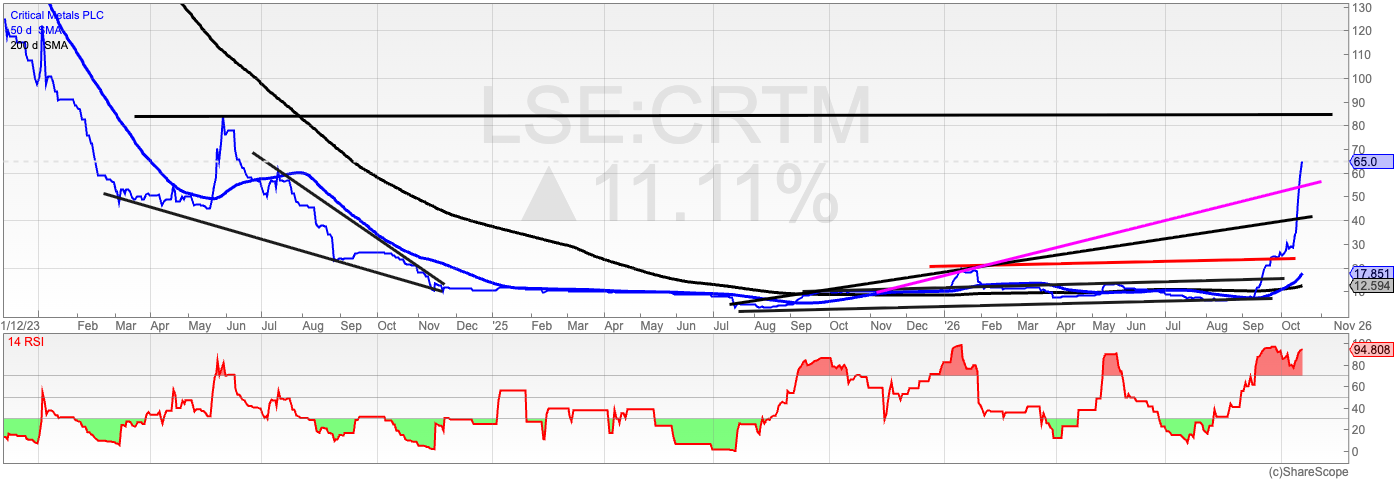
Therefore, for Critical Metals Critical Metals (CRTM) to have to say the following is so lame: “The board of directors has noted the recent rise in the Company’s share price and confirms that it knows of no reason for this increase.” Anything else would have been more helpful. For instance, we are called Critical Metals, and critical metals are on fire at the moment. Or even, after years of bubbling under our time have finally come. Or the best: Zak Mir has called up the shares from under 10p last month, and given that they are 60p plus now, he is really good at technical analysis. 85p by the end of the month anyone?
Halo Minerals (HALO) Halo Minerals (HALO)
Halo Minerals have rallied from the lower levels seen last month. However, in the wake of this week’s strong update from the copper development company focused on recovering critical minerals from legacy mining waste, one might have expected them to be back at their spring highs near 19p. This is said on the basis that on Friday the company revealed an increased Ore Reserve and improved project economics. They were as follows:
Ore Reserves increased by 1.74 Mt, or approximately 5.4%, to 33.94 Mt at 0.25% Cu, containing 83,626 tonnes of in-situ fine copper.
The Ore Reserve base case produces an after-tax NPV10 of US$174.3 million and an after-tax IRR of 45.6% with project level average annual free cashflows of US$56 million.
Total Mineral Resources are 53.44 Mt at 0.24% Cu, inclusive of Ore Reserves, containing 127,911 tonnes of in-situ fine copper.
A separate full-resource management case, using the full 53.44 Mt onshore Mineral Resource, produces an after-tax NPV10 of US$267.5 million and an after-tax IRR of 48%.
Identified CAPEX and reagent-cost optimisation increases the after-tax NPV10 to US$190.6 million for the Ore Reserve case and US$295.5 million for the full-resource management case.
EMI identifies preliminary potential to increase Ore Reserves by approximately 25% to 30% in the short term, subject to further technical work and confirmation of modifying factors.
All in all, nothing to be sniffed at. This is especially so given the way that the current market cap is just under £9m, so pocket change.
Hydrogen Utopia (HUI) Hydrogen Utopia International Plc | HUI:LN
Given that earlier this month we saw the spectacle of President Trump breaking his own sanctions to go cap in hand to buy diesel off Russian President Putin, there is little doubt that there are supply chain issues in the world of fossil fuel. That is unless one believes that Trump did not actually need the diesel, but Putin is really running out of cash.
Surprisingly, this theory has not get received much airtime. However, we can assume that if diesel prices are sky high due to supply issues, the same is the case as far as aviation fuel. In fact, aviation fuel has risen up to 100%, whereas diesel is up 40%. So there really should be a crisis in air travel. This has perhaps not happened as badly as it could have given many airlines hedge prices, and (what a rip off) fuel is only 20% - 30% of the ticket price. Nevertheless, it remains a surprise that Hydrogen Utopia, which is focused on the sustainable aviation fuel market, has not seen its shares soar in recent months as the Iran crisis has continued. This is even more the case in that even if the Iranian situation were to end tomorrow there would still be extended supply constraints.
But even more importantly, going forward airlines are going to be mandated to use more and more of it in their planes in coming years and decades. This implies HUI is onto a winner, something which is currently belied by its £10m market cap. As in the case of HALO described above, the London market is not big on looking forward / anticipating very much, or adding sizzle to a story.
Medpal (MPAL) Medpal (MPAL)
There can be little doubt that Medpal is riding the crest of a wave as far as the GLP-1 / weight loss phenomenon, of which even yours truly is a partaker. Indeed, I have lost 25kg on Mounjaro, something which provides some comfort against recently turning 60. This week it was revealed that Eli Lilly, the exclusive supplier of GLP-1 Mounjaro, confirmed that Medpal's New Health has risen from 3,048th to 29th place in its supplier list (by volume supplied). This has taken approximately three months since the Company's initial marketing campaign began. If nothing else it can be seen that MPAL's New Health has hit the ground running in a highly competitive field. One looks forward to it hitting the top ten before Christmas.