
Cadence Minerals (KDNC) said Macarthur Minerals is to commence a geotechnical drilling campaign to support mine planning work being undertaken as part of the current Feasibility Study for its flagship Lake Giles Iron Project in the Yilgarn region of Western Australia.
The drill programme is planned to commence during July and will involve the drilling of 8 diamond core holes for a depth of 1560m, with varying depths of between 175 to 230m each.
The programme will commence at the Moonshine magnetite resource and will be undertaken ‘as efficiently as possible’. In total, it is expected to take between 6 to 8 weeks to complete.
Macarthur Minerals’ Chief Executive, Andrew Bruton said the programme represented an “ important phase of drilling work” which will provide information targeting the footwall and the hanging wall of the main pits for the first phase of magnetite mining operations at Moonshine.
The Company said the information will be used to support mine planning work being undertaken by Orelogy Mine Consulting and Pells Sullivan Meynink ("PSM") as part of Macarthur's current Feasibility Study for its high grade magnetite Lake Giles Iron Project.
Figure: Lake Giles Iron Project preliminary layout showing planned geotechnical holes.
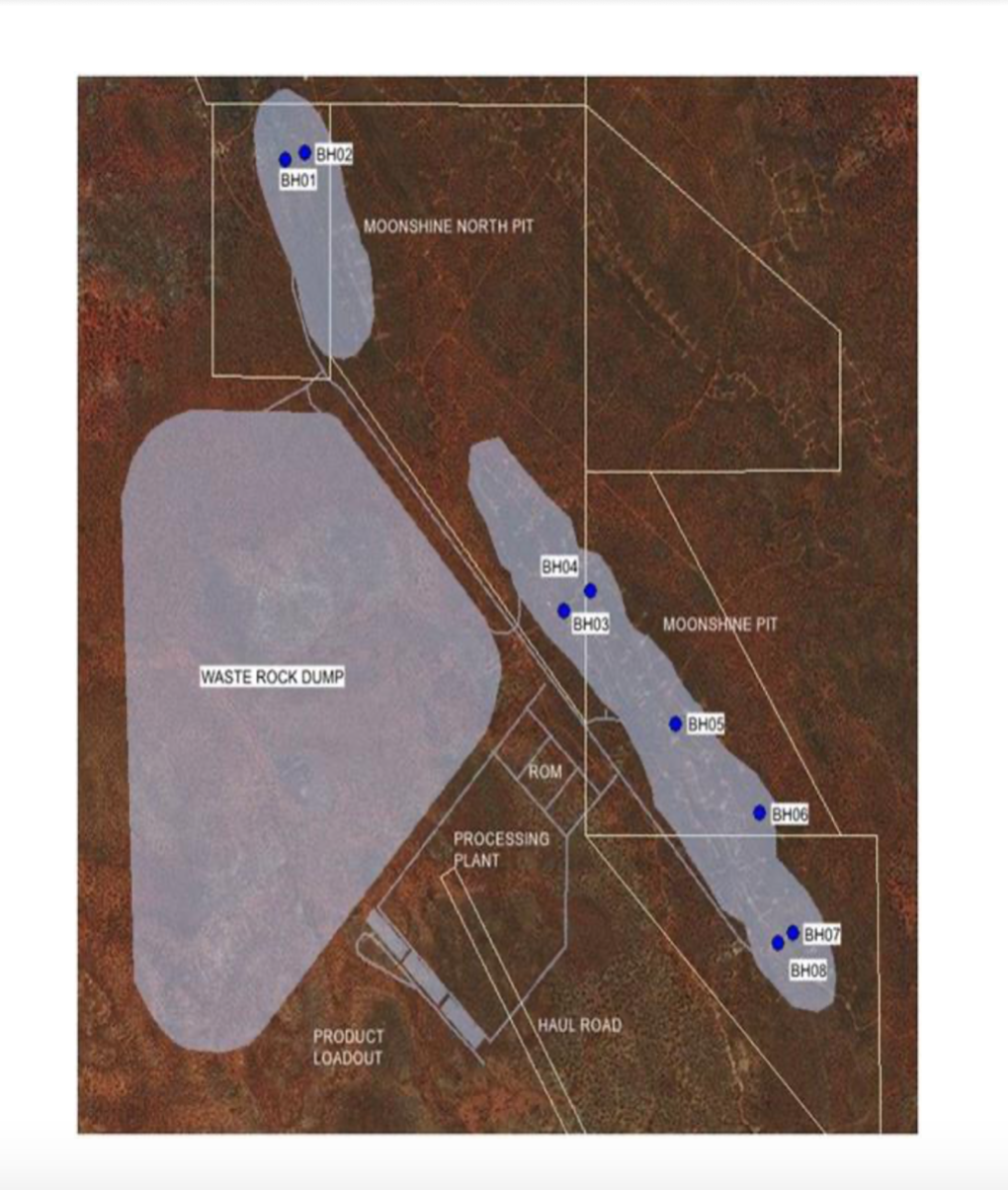
(Source: Macarthur Minerals Limited)
Cadence said the scheduling of the drill programme aligns with its expectations for delivery of the Feasibility Study at Lake Giles. Meanwhile, Bruton added that, “The mobilisation of the drill crew and equipment on site will commence shortly and we look forward to keeping investors updated on the progress of this work over the course of the next few months."
Last week, Macarthur Minerals said it had made an application for additional tenure adjacent to the company’s flagship Lake Giles Iron Project in the Yilgarn region of Western Australia.
The tenure, which is adjacent to the Snark deposit of the Ularring Hematite Project, will support Macarthur's non-process infrastructure for its planned direct-shipping iron ore ("DSO") campaign, initially targeting mining of the Snark and Drabble Downs deposits at Lake Giles.
London-listed Cadence holds approximately 1% of the issued equity interest in Macarthur, which is an Australian mining exploration company focused primarily on iron ore, nickel, lithium and gold in Western Australia. It also has a lithium project in Nevada, USA.
View from Vox
Last week, Cadence said its strategic efforts to drive the value of its assets bore fruit in the year ended 31 December 2020 as the company turned over a net profit of £7.8 million.
The London-listed firm said it has continued to pursue its strategic objectives despite 2020 being ‘a year of turbulence’, resulting in the Company delivering both a net profit of £7.8m (2019: loss of £1.9m) and reporting considerable progress across its key investments.
As a result, the Company was able to repay all outstanding convertible debt by April 2021. The Group’s net assets at the end of the period was £22.09 million (FY19: £10.99 million) - this increase of approximately £11.1m reflects the profits and shares issued in the year.
CEO of Cadence Minerals, Kiran Morzaria, said he believes the Company’s ‘diverse and complementary nature of investments is uniquely positioned, with downside risk protection and several potential scenarios which could create substantial value to the Company.’
Shares in Cadence Minerals have almost doubled in value since the beginning of 2021. The stock was trading 0.82% higher this morning at 29.49p immediately following the news.
In September 2020, DEV, Cadence and Indo Sino Pty ("the Investors") agreed in principle to the settlement terms proposed by the secured bank creditors ("Bank Creditors").
The execution of a settlement agreement with the Bank Creditors would represent the satisfaction of Cadence's remaining major precondition to make its initial 20% investment in Amapa. On completion of the conditions and the release of the Cadence escrow monies, it will become a 20% shareholder in Amapa via its JV company, which will own 99.9% of DEV.
Amapá – 30% (once final agreement with bank creditors has been completed)
Candece plans to rehabilitate Amapá, including commissioning the studies required of bank finance, shipping of the iron ore from the stockpile and the restarting of full operations.
The historic mine plan would mean that Amapá would produce at steady-state production an estimated 4.4 Mt of 65% iron and 0.9 Mt of 62% iron per annum for approximately 14 years.
Cinovec – 16%
Cadence holds around 12% of the equity in European Metals, which, through its subsidiary, Geomet, controls the exploration licences awarded for the Czeach Cinovec Lithium Project.
Cinovec, which is the largest hard rock lithium deposit in Europe, is strategically located to produce lithium for Europe with the goal of contributing to a sustainable supply chain for a world leading centre for electric vehicle development and manufacture in Europe.
Diego Pavia, CEO of EIT InnoEnergy, said he views Cinovec as “critical” to the development of Europe's energy storage industry and in meeting the EU's climate goals of electrification of mobility and large-scale development of renewable energy storage.
Last week, the ongoing nineteen-hole resource drilling programme at the Cinovec Project returned strong drilling results. Cadence’s Chief Executive, Kiran Morzaria told investors that the encouraging results ‘serve to highlight the overall quality of the Cinovec project.’
Yangibana – 30%
Last year, Cadence unveiled ‘outstanding’ rare earth oxide grades in a report which highlighted positive drilling results at the Yangibana rare earth project in Australia, exceeding its expectations for its planned 20,000 metre 2020 exploration drill program.
Cadence, which owns 30% of three mining leases and six exploration licences which form part of the Yangibana Rare Earth Deposit, expects to advance the programme until Q420.
Follow News & Updates from Cadence Minerals here: