
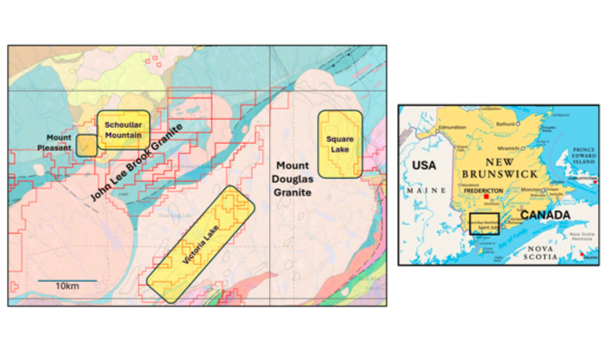

Rome Resources (RMR ) is to commence its field programme on its New Brunswick tin-tungsten-indium properties in Eastern Canada this week.
As operator, Rome Resources expects to incur a maximum of C$150,000 in costs in relation to the 2026 field programme, following which it will assess its position regarding the exercise of the option on the properties, which it acquired in March.
The option covers 109 square kilometres of mining claims close to the Mount Pleasant deposit, hosting the Three Lakes and Schoullar Mountain projects.
Rome plans to take over 500 samples from surface and trench sampling this summer. Substantial showings of the target minerals have already been identified across the district.
The company's decision to explore in New Brunswick reflects both the prospectivity of the district and its position within a stable North American mining jurisdiction.
The region hosts extensive granite-related mineralisation, including critical minerals such as tin, tungsten and indium, commodities which continue to attract increasing strategic attention globally.
Rome is focussing on three key areas: Schoullar Mountain, Square Lake, and Victoria Lake.
Schoullar Mountain is located a few kilometres east of the historic Mount Pleasant tungsten mine and in the vicinity of an undeveloped tin zone. The target lies within the same broader mineralised system as Mount Pleasant. The programme in this area will focus on sampling along four historical induced polarisation (IP) profiles, including trenching in two areas where the IP chargeability is interpreted to be close to surface. IP chargeability is a commonly used technique to detect sulphide and other metallic ore constituents.
At Square Lake, samples will be taken in the vicinity of historical workings, while at Victoria Lake work will gocus on the greisenised phase of the Mount Douglas granite, where multiple showings of tin and tungsten have been identified.
In line with New Brunswick's stated policy of supporting mineral exploration, as operator, Rome Resources has been awarded an exploration grant covering a portion of its 2026 Field Programme expenditures.
"The Mount Douglas granite system hosts one of the most prospective tin-tungsten-indium districts in eastern Canada, including the historic Mount Pleasant tungsten mine,” said Paul Barrett, chief executive of Rome Resources.
“The potential for tin, tungsten and indium resources in the Mount Douglas and associated granite systems potentially represents a significant opportunity for the company and, with tungsten now firmly established as a strategically important critical mineral, we are delighted to be advancing the first field programme as operator across the project area. The enthusiasm shown by the Province of New Brunswick for developing its resources demonstrates that we are pushing on an open door, and we look forward to potentially unlocking the potential of this highly prospective region, subject to the exercise of the option.”
View from Vox
The New Brunswick operations represent an intriguing extra string to Rome’s bow. Most of the attention, and for now at least, much of the value creation, will remain focussed on the company’s projects in the Democratic Republic of Congo, which are advancing well. But New Brunswick provides long-term upside in a safe jurisdiction and in commodities that the world is currently crying out for. The exploration at this point is low cost, and the potential rewards could be significant.