

ECR Minerals (ECR ) has identified a new drill target on the Lolworth project in Queensland.
New assays have helped delineate a well-defined 200-metre north-northeast trending gold corridor on the Butterfly Creek prospect on Lolworth.
Sixteen soil samples returned greater than 100 parts per billion gold, outlining a well-defined mineralised system. The highest assay returned ran to 3,510 ppb gold.
The gold anomaly identified branches into a second northeast-trending structure associated with a quartz outcrop.
The gold anomaly was not detected during earlier portable X-Ray Fluorescence analysis, demonstrating the necessity of laboratory analysis as an additional exploration technique to identify gold mineralisation.
The Lolworth Project covers approximately 946 km² within the highly prospective Hodgkinson Gold Province of North Queensland, and is ECR's largest exploration asset.
In December 2025, the company released maiden drilling results from the Uncle Terry and Gorge Creek West prospects, confirming a gold-silver system and demonstrating the significant exploration potential across the project.
Those discoveries originated from a systematic soil sampling programme undertaken between 2023 and 2024. Initial interpretation relied primarily on portable X-Ray Fluorescence analysis to identify pathfinder elements such as lead, arsenic and silver that could indicate nearby gold mineralisation.
Whilst this approach successfully identified the mineralisation subsequently drilled at Uncle Terry and Gorge Creek West, pXRF technology cannot directly detect low concentrations of gold.
To further evaluate the wider exploration potential of Lolworth, ECR submitted approximately 1,500 soil samples for laboratory fire assay and Inductively Coupled Plasma analysis at Onsite Laboratory Services in Bendigo, Victoria. The samples covered both the Butterfly Creek and Uncle Terry prospects.
A total of 500 soil samples were collected across Butterfly Creek on a systematic 25 metre by 25 metre grid, with selected areas around quartz outcrop infilled to 15 metre spacing.
Laboratory analysis has accordingly defined a coherent gold anomaly striking north-northeast over approximately 200 metres.
The anomalous gold values extend beyond the mapped quartz exposures, indicating the mineralised system has the potential to continue beneath shallow cover.
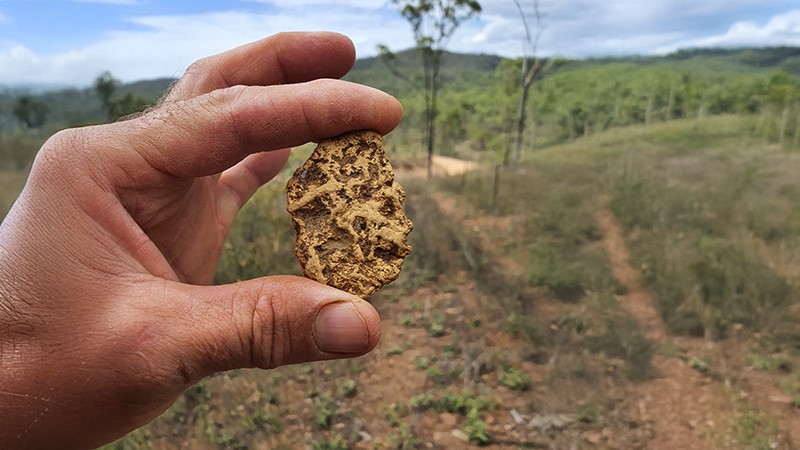
Historical metal detector activity along the ridge has also recovered several rich gold-bearing quartz specimens directly above the newly defined gold corridor, providing additional confidence that the surface geochemistry should reflect an underlying bedrock gold system.
Follow-up exploration is now planned, including detailed geological mapping and an initial drill programme to test the newly identified target.
"These are some of the most exciting soil results we've generated at Lolworth to date,” said Adam Jones, ECR’s chief geologist.
“Rather than isolated gold values, we've identified a well-defined mineralised corridor extending for around 200 metres, with gold values reaching 3.51 grams per tonne in soil samples. Perhaps just as importantly, this target was not identified using conventional pXRF pathfinder analysis. It only became apparent once the samples were analysed by laboratory fire assay. That validates the exploration model we wanted to test and demonstrates the value of laboratory gold analysis in identifying mineralisation that may otherwise remain undetected. Combined with our encouraging maiden drilling results at Uncle Terry and Gorge Creek West announced last year, these latest assays continue to reinforce our view that Lolworth is evolving into a district-scale gold system containing multiple independent exploration targets."
View from Vox
These results further demonstrate the extent of exploration opportunities within ECR's Queensland gold portfolio, complementing the company's production-focused activities at Raglan, Maddens and Blue Mountain. ECR is beginning to develop into that classic model of a junior mining company – one with significant enough production to pay for costs and exploration, and with significant enough exploration upside still to have the potential to be a ten-bagger.